Keralth
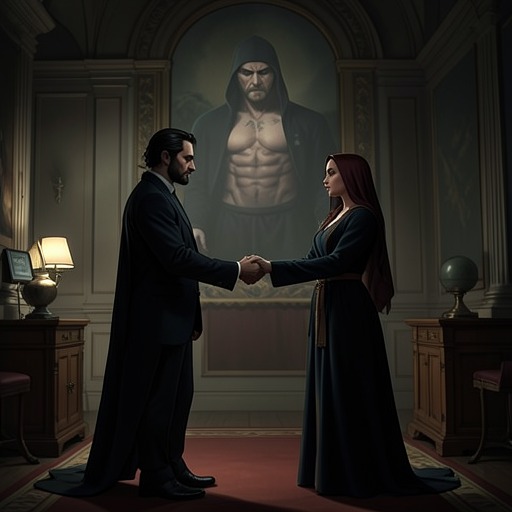
The Vampire Prince’s BrideKeralth is a young Drakonaar man positioned beside his father, Lord Rezelith, King of Rothgar, during Darilth’s formal presentation of Ella. He wears dark pants and a dark cloak resembling Darilth’s, visually placing the two men within the same princely and martial world. At his side stands a beautiful but drained-looking woman, identified by Rezelith as Keralth’s mate. The scene gives Keralth no independent speech, but his placement beside the king and his composed appearance mark him as an established presence at court rather than a peripheral observer.
Position at the Rothgar Court
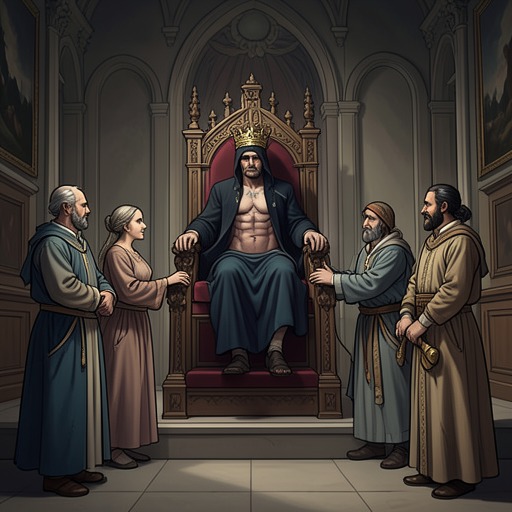
Keralth appears in the throne room while Lord Rezelith sits on a dark-stone throne surrounded by guards. The hall’s cold architecture and the ice-covered planet outside reinforce the atmosphere of severity in which Keralth is introduced. He is not summoned forward or required to defend his status; he already occupies a place beside the king, while Darilth must approach formally and introduce Ella as his true mate.
Rezelith explicitly elevates Keralth as a model for Darilth. The king says that Keralth found his mate long ago and describes her as a good partner: she could not awaken the stone, but she is a strong, trained warrior. This comparison is designed to diminish Ella, whom Rezelith calls weak because she is human, while presenting Keralth’s relationship as the acceptable standard. Keralth therefore functions within the scene not merely as a brother but as evidence in his father’s argument about strength, usefulness, and suitability.
Rivalry with Darilth
Keralth’s conflict with Darilth is communicated through gesture and reaction rather than open argument. When Darilth looks toward him, Keralth wears a smirk as he studies Ella. Darilth experiences the expression as contemptuous and wants to strike him in the face. That reaction establishes a charged rivalry: Keralth’s apparent amusement intensifies Darilth’s humiliation, while Darilth’s anger reveals that Keralth is already associated with the judgment being imposed on him.
The brothers are thus contrasted by their positions in the same family structure. Keralth has a long-established mate and a partner praised for martial strength; Darilth has only just found Ella and must ask his father to recognize the bond. Darilth’s claim that Ella is his true mate is rejected, while Keralth’s relationship is invoked as proof of what a successful princely match should resemble. The comparison makes Keralth a threshold figure in Darilth’s crisis: his accepted status helps close the royal household against Darilth and Ella.
Relationship to Ella and the King’s Judgment
Keralth does not directly speak to Ella or physically threaten her in the recorded encounter. Nevertheless, his gaze contributes to her sense of danger. After Rezelith dismisses Darilth, Ella leaves the throne room in tears, fearing that she may be treated as a slave and believing that the hostile Drakonaar might kill her if given the opportunity. Keralth’s smirking scrutiny is part of the hostile courtly environment through which she interprets that threat.
His association with Rezelith is equally important. The king’s lack of kindness toward Darilth is made unmistakable, and Keralth’s visible satisfaction contrasts with Darilth’s desperate appeal for reconsideration. Keralth consequently appears aligned, at least in this moment, with the royal order that values combat readiness and Drakonaar superiority over Ella’s status as Darilth’s chosen mate. The evidence does not establish whether Keralth independently shares all of Rezelith’s beliefs, but it clearly shows him benefiting from the comparison.
Narrative Function
Keralth’s brief appearance compresses several conflicts into one throne-room tableau: brothers competing for paternal regard, a king defining worth through strength, and a human outsider being measured against Drakonaar expectations. His dark clothing mirrors Darilth’s, yet the difference in their treatment exposes the unequal standing between them. Keralth does not need to challenge Darilth openly; a smirk and a privileged position beside the king are enough to make the rivalry legible.
Because the available evidence ends with Darilth escorting Ella away, Keralth’s later actions, motives, and ultimate fate remain unspecified. What the scene firmly establishes is his role as Darilth’s brother and rival, the mate of a warrior whom Lord Rezelith praises, and a court figure whose presence helps turn Darilth’s hoped-for recognition into rejection and exile-like humiliation.